

TL;DR
- Public cloud offers flexibility, lower upfront costs, and on-demand scalability, while private cloud provides greater control, customization, and support for sensitive workloads.
- Hybrid cloud combines both models, making it a practical choice for businesses that need to balance security, performance, and scalability across different systems.
- The right cloud model depends on your workloads, compliance needs, budget, and how much control or agility your organization requires.
- Evaluating where each application fits can help your business improve efficiency, support modernization, and choose a cloud strategy that aligns with long-term goals.
Nearly all (98%) organizations use some form of cloud services for business operations.1 However, choosing the right cloud model significantly impacts efficiency, security, and bottom-line results. The decision between public, private, or hybrid cloud deployment shapes how your business stores data, runs applications, and scales for the future.
In this guide, we’ll explore the three main types of cloud computing – public, private, and hybrid – to help you understand their unique benefits and potential drawbacks for your business.
What Is Cloud Computing?
Cloud computing delivers computing services, including servers, storage, networking, software, and more, over the internet. Rather than having to maintain physical servers and run software applications on your own machines, cloud computing services let you access enterprise systems and applications through the internet.
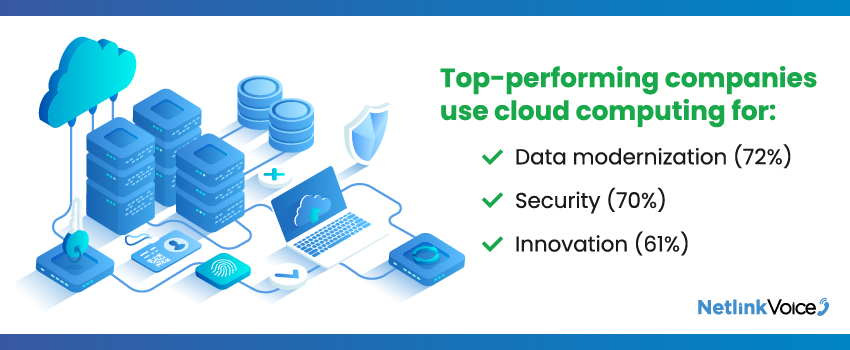
A 2024 PWC survey found that top-performing companies are embracing cloud computing for benefits like data modernization (72%), security (70%), and innovation (61%).2 Organizations can choose from three primary cloud deployment strategies: public, private, and hybrid. Read on to explore what these cloud computing strategies offer.
Public Cloud Pros & Cons
Public cloud deployments are like renting space in a shared building. You get all the amenities you need, but you share the infrastructure with other tenants. It’s a cloud environment where computing resources are owned and operated by public cloud providers and delivered to your business via the Internet.
Pros Of Public Cloud
Public cloud services offer several advantages for organizations, including:
-
- Cost-Effectiveness: Public cloud solutions eliminate the need to pay for extensive hardware and ongoing maintenance costs. You only pay for the resources you use, making it a more economical choice for many businesses.
-
- Scalability On-Demand: You can scale public cloud services up or down instantly to meet your organization’s fluctuating needs and ensure you have the right computing resources when you need them.
-
- No Maintenance Headaches: Your public cloud provider handles all maintenance, updates, and security patches, freeing your IT team to focus on more than routine upkeep.
-
- High Reliability: Public cloud environments offer redundancy and minimal downtime with multiple data centers spread across different locations, ensuring your business stays operational.
The public cloud’s flexibility and cost-effectiveness make it an appealing option for businesses looking to modernize their IT infrastructure without significant upfront investment.
Cons Of Public Cloud
Public cloud deployments also come with potential drawbacks to consider, such as:
-
- Security Risks: Sharing infrastructure with other organizations can raise security concerns, particularly for sensitive data or compliance-heavy industries.
-
- Potential Performance Issues: Since resources are shared, you might experience performance variations during peak usage times.
-
- Limited Customization: Public cloud services are standardized to serve many customers, which may limit your ability to customize the infrastructure to your specific needs.
-
- Data Privacy Regulations: Depending on your industry, storing data in a public cloud solution might not comply with certain regulatory requirements.
Many organizations find that the benefits of public cloud services outweigh the drawbacks, especially when implemented with proper planning and cloud security measures.
Private Cloud Pros & Cons
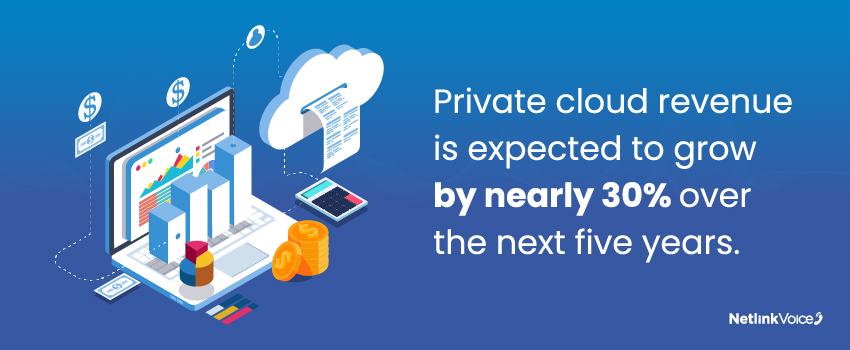
Private cloud environments are like owning your own building – they’re dedicated solely to your business, so you get maximum control. In technical terms, a private cloud is a cloud computing environment used by only one organization, which means more security and control. Private cloud usage remains strong, with revenue expected to grow by nearly 30% over the next five years.3
Pros Of Private Cloud
Private cloud services offer several advantages for organizations with specific needs:
-
- Enhanced Security: The private cloud is ideal for handling sensitive data since it includes dedicated resources, so you have complete control over your security measures.
-
- Customization Freedom: Your organization can tailor a private cloud environment to meet your exact needs, ensuring optimal performance for your unique workloads.
-
- Predictable Performance: Since you’re not sharing resources with other organizations, you can count on consistent performance levels.
-
- Complete Control: You have full visibility and control over your data, making it easier to manage and monitor your IT environment.
For companies that prioritize security and control, private cloud infrastructure provides an ideal solution that can be customized to meet specific business needs.
Cons Of Private Cloud
Consider these potential drawbacks of private cloud deployment:
-
- Higher Costs: Setting up and maintaining a private cloud involves significant upfront investment in hardware and ongoing maintenance.
-
- Limited Scalability: Scaling up requires purchasing and installing new hardware, which can be time-consuming and expensive.
-
- Resource-Intensive: Managing a private cloud requires dedicated IT staff with specialized expertise, adding to operational costs.
-
- Potential for Underutilization: Since resources are dedicated, you might end up paying for capacity you don’t always need.
Organizations with specific security needs or regulatory requirements often find the private cloud to be the most suitable option despite these challenges.
Hybrid Cloud Pros & Cons
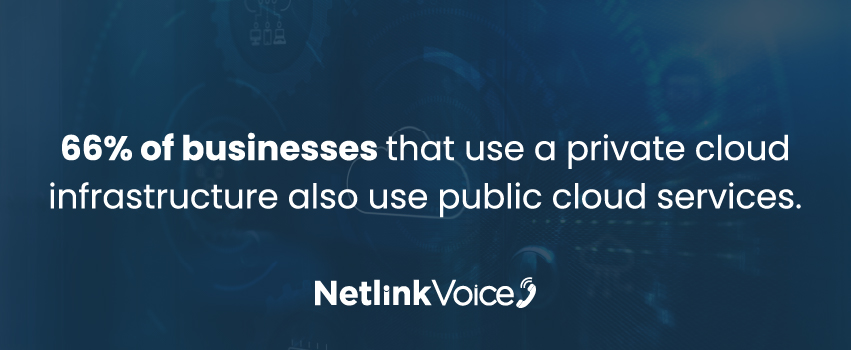
Hybrid cloud computing is like having both a private office and access to shared spaces – you get the best of both worlds. It combines public and private clouds so businesses can share data and applications between them. It’s also an increasingly popular approach to cloud computing, with 66% of companies using a private cloud infrastructure also using public cloud services.4
Pros Of Hybrid Cloud
A hybrid cloud solution offers unique benefits for organizations, such as:
-
- Increased Flexibility: Hybrid cloud solutions enable you to use public cloud offerings for less sensitive operations while keeping critical data in your private cloud.
-
- Cost Optimization: Your IT teams can balance workloads between private and public clouds to maximize cost efficiency.
-
- Secure Scalability: A hybrid cloud strategy lets you use public cloud resources while maintaining security for sensitive data in your private cloud environment.
-
- Business Continuity: You can distribute cloud resources across both private and public cloud environments to improve disaster recovery capabilities.
Hybrid clouds provide a “best of both worlds” approach, allowing organizations to leverage the advantages of both private and public clouds.
Cons Of Hybrid Cloud
Along with these benefits, a hybrid cloud model also comes with potential challenges to consider. These include:
-
- Increased Complexity: Managing two different cloud environments can be complex and often requires specialized expertise.
-
- Integration Challenges: Ensuring seamless operation between your public and private cloud environments can be technically challenging.
-
- Higher Initial Costs: While potentially cost-effective in the long term, setting up a hybrid cloud takes significant initial investment.
-
- Security Considerations: Moving data between public and private clouds requires careful security planning and execution.
Many businesses find that a hybrid cloud approach provides the ideal balance of flexibility, security, and cost-effectiveness despite these challenges.
Public, Private & Hybrid Cloud: Side-By-Side Comparison
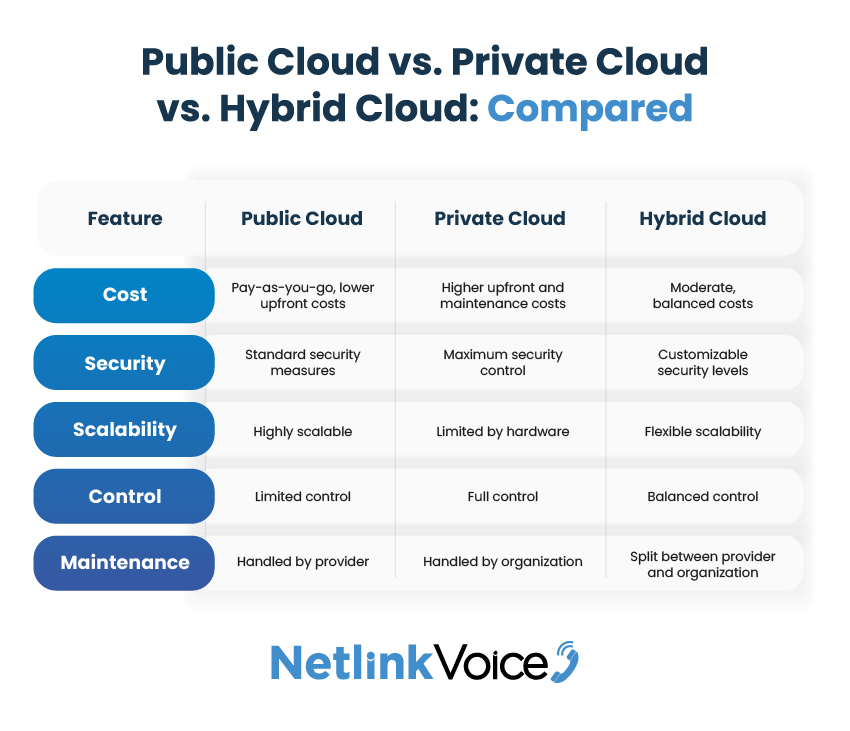
Let’s break down the key differences between these three cloud models:
When considering cloud deployment options, it’s important to understand the role of a cloud service provider (CSP). These third-party cloud providers offer a range of cloud computing services, including infrastructure, platforms, and software as a service (IaaS, PaaS, and SaaS). Many companies opt for a multi-cloud strategy, leveraging services from multiple cloud providers to improve performance and costs.
How To Choose Between Public, Private & Hybrid Cloud
Choosing between public, private, and hybrid cloud isn’t just about cost. It’s about matching the right environment to your applications, security requirements, performance expectations, and internal resources. In many cases, the best choice comes down to how much control you need, how sensitive your data is, and how quickly your workloads need to scale. NIST defines public, private, and hybrid cloud as distinct deployment models, while IBM notes that hybrid environments are often used to connect private, public, and on-premises resources in a more flexible operating model.
Choose Public Cloud If Flexibility & Speed Matter Most
A public cloud model often makes the most sense when your business wants to move quickly, avoid large capital investments, and scale resources on demand. It’s especially useful for organizations that want to reduce infrastructure management overhead and pay only for what they use. For growing businesses, development teams, and organizations with changing demand, public cloud can offer a faster path to deployment and expansion.
Choose Private Cloud If Control & Compliance Come First
Private cloud is often the better fit when your environment must support stricter security controls, specific compliance obligations, or highly customized workloads. Because resources are dedicated to one organization, private cloud can provide greater visibility, more predictable performance, and more control over how systems are configured and managed. That makes it a strong option for businesses running sensitive applications or supporting workloads that are not a good fit for shared infrastructure.
Choose Hybrid Cloud If Your Needs Don’t Fit Neatly Into One Model
Hybrid cloud works well when some workloads belong in a more controlled environment while others benefit from the scalability and elasticity of the public cloud. It can also make sense for organizations that are modernizing gradually, keeping certain legacy applications or sensitive data in a private environment while moving other services to the cloud over time. Gartner has said that 90% of organizations will adopt hybrid cloud through 2027, which reflects how common this mixed approach has become.
The Right Choice Depends On Business Fit, Not Just Technology
In practice, there is no universal “best” cloud model. The right fit depends on your budget, compliance obligations, application architecture, performance needs, and the level of IT expertise available to support the environment. Businesses that take time to evaluate workloads individually are usually in a much better position to choose a cloud strategy that supports both current operations and future growth.
Which Workloads Belong In Public, Private, Or Hybrid Cloud?
Not every workload belongs in the same environment. Some applications need maximum elasticity. Others need tighter control, lower variability, or support for legacy dependencies. Looking at workload requirements, rather than cloud labels alone, is often the clearest way to decide where a system should run. IBM’s guidance on hybrid cloud emphasizes choosing the best environment for each application or workload, which is often the most practical approach for real-world IT environments.
Public Cloud Workloads
Public cloud is often a strong fit for workloads that need rapid provisioning, flexible scaling, or broad accessibility. This can include development and testing environments, collaboration platforms, customer-facing applications with fluctuating traffic, backup targets, and analytics workloads that benefit from elastic resources. When demand rises and falls unpredictably, public cloud makes it easier to scale without investing in permanent infrastructure you may not always need.
Private Cloud Workloads
Private cloud is usually better suited to workloads that require tighter governance, dedicated performance, or a higher degree of customization. That can include regulated applications, systems containing highly sensitive business or customer data, and legacy applications that depend on configurations not easily replicated in a shared public environment. It can also be the right choice when your organization needs more direct control over security policies, data handling, or system performance.
Hybrid Cloud Workloads
Hybrid cloud is often the best fit when workloads need to be split across environments based on sensitivity, performance, or operational readiness. For example, an organization might keep core systems or regulated data in a private cloud while using public cloud resources for web applications, seasonal demand spikes, backup, disaster recovery, or application modernization. Hybrid cloud can also support phased migration strategies, allowing businesses to move at a pace that makes sense instead of forcing every application into the same model at once.
Workload Placement Should Be Strategic
The most effective cloud strategies are rarely built by treating every application the same way. Instead, they evaluate each workload based on security, compliance, latency, integration needs, scalability, and operational complexity. That is one reason hybrid models continue to gain traction: they allow organizations to align cloud choices with actual business and technical requirements, rather than forcing an all-or-nothing decision.
Real-World Examples Of When Each Cloud Model Makes Sense
Sometimes the differences between cloud models are easiest to understand in context. While every environment is different, a few common business scenarios show why one model may be a better fit than another.
When Public Cloud Makes Sense
A business launching new applications quickly or dealing with shifting demand often benefits from public cloud. A growing company may not want the cost or complexity of building out dedicated infrastructure before it knows exactly how usage will scale. In that case, a public cloud model can provide the speed, elasticity, and lower upfront commitment needed to support growth.
When Private Cloud Makes Sense
A private cloud model can make more sense for organizations handling sensitive records, supporting stricter compliance requirements, or relying on applications that need a more controlled environment. It can also be a strong fit when performance consistency and infrastructure customization matter more than rapid elasticity. In those situations, the added control of a dedicated environment can outweigh the higher cost and management burden.
When Hybrid Cloud Makes Sense
Hybrid cloud is often the most practical choice for organizations that need to balance modernization with operational reality. For example, a company may want to keep core systems, sensitive data, or legacy applications in a private environment while using public cloud services for new applications, remote access, business continuity, or scalable workloads. This approach can reduce disruption while still giving the business room to modernize and grow.
Why Many Organizations End Up With A Hybrid Approach
In reality, many organizations are not choosing between public cloud, private cloud, and hybrid cloud as if only one can apply. They are choosing how to combine the right environments for the right purposes. That is part of why hybrid adoption remains so strong. For businesses with a mix of legacy systems, security requirements, and growth goals, a hybrid strategy often provides the flexibility to move forward without overcommitting to a single model too soon.
Public Cloud vs Private Cloud vs Hybrid Cloud FAQs
What Is The Main Difference Between Public, Private, And Hybrid Cloud?
The main difference is how infrastructure is deployed and shared. Public cloud uses provider-owned resources shared across customers, private cloud uses dedicated resources for one organization, and hybrid cloud combines multiple environments so workloads can run where they make the most sense.
Is Public Cloud Less Secure Than Private Cloud?
Not necessarily. Public cloud providers can offer strong security capabilities, but the fit depends on your data, compliance requirements, and how much control your organization needs. Private cloud is often preferred when dedicated infrastructure and tighter governance are important.
Why Do Businesses Choose Hybrid Cloud?
Many businesses choose hybrid cloud because it allows them to keep sensitive workloads in a private environment while using public cloud for scalability, backup, modernization, or less sensitive applications. It offers more flexibility than relying on one model alone.
Which Cloud Model Is Best For Legacy Applications?
That depends on the application. Some legacy systems can move to the public cloud with the right planning, but others are better suited to private cloud or hybrid cloud because of performance dependencies, security needs, or architectural limitations.
Is Hybrid Cloud More Expensive?
Hybrid cloud can involve more planning, integration, and management complexity, which may raise initial costs. However, it can also improve long-term efficiency by placing each workload in the environment that best balances cost, performance, and control.
How Do I Know Which Cloud Model Is Right For My Business?
Start by evaluating your workloads, compliance obligations, performance requirements, internal IT resources, and growth plans. The right choice is the one that aligns best with how your business actually operates, not just the newest or cheapest option.
Find The Right Cloud Solution With Netlink Voice
From managing costs and resources to ensuring data protection and operational efficiency, your cloud deployment choice fundamentally shapes how your organization leverages technology to achieve its goals. Ultimately, the right approach for your business will align with your objectives, address security and compliance requirements, and provide the flexibility to adapt as your needs evolve.
At Netlink Voice, we build solutions with your organization’s needs in mind. We understand that not all legacy applications are obsolete, and some may not easily migrate to the public cloud. That’s why we offer flexible solutions, including a hybrid cloud approach for workloads that aren’t fully cloud-ready.
For businesses that need more reliability, flexibility, and security, our private cloud solutions offer a single-tenant cloud environment – backed by support you can rely on. Plus, our built-in redundancy and data backups mean we’re prepared to restore services quickly, even if a disaster strikes. Ready to transform your business with a fully hosted private cloud solution? Book a demo today!
Sources: