

TL;DR
- Hosted VoIP is a cloud-based business phone system that routes calls over the internet while the provider manages the infrastructure, updates, and core maintenance.
- It offers practical advantages like lower hardware overhead, easier scalability, advanced calling features, and better support for remote or hybrid teams.
- To run hosted VoIP successfully, businesses need a stable internet connection, compatible devices, and a provider that can support reliability, security, and long-term growth.
- Hosted VoIP, hosted PBX, and cloud VoIP are closely related terms, but the right solution depends less on the label and more on the features, flexibility, and support behind it.
If you’re researching modern phone systems for your business, you’ve probably come across the term hosted VoIP – short for hosted Voice over IP. Analysts predict the VoIP services market will reach $108.5 billion by 2032,1 so it’s clear that more organizations are turning to this flexible, scalable technology. But what is hosted VoIP, and how does it compare to traditional phone systems or on-premise VoIP solutions?
In this blog, we’ll explain what hosted VoIP is, how it works, and what to look for in a hosted VoIP service for your company.
What Is Hosted Voice over IP?
Hosted VoIP is a cloud-based phone service that sends voice calls through the internet. Users make and receive calls via IP-enabled phones, mobile apps, or desktop software, with all the call routing, voicemail, conferencing, and system management taking place offsite – hence the term “hosted.”
Unlike a traditional private branch exchange (PBX) located onsite, a service provider manages the hosted VoIP system’s equipment, servers, and system updates in the cloud. This takes the burden of ongoing management and maintenance off your IT teams so they can focus on other priorities.
Many modern hosted VoIP solutions are part of a unified communications as a service (UCaaS) platform, which combines voice, video, messaging, and collaboration into a single cloud-based system to create a more cohesive communication environment.
How Does Hosted VoIP Work?
Hosted VoIP for business works by turning voice into digital data and transmitting it over the internet instead of traditional phone lines. Although the technology behind it is sophisticated, the calling experience feels seamless to the user.
Voice Is Converted Into Digital Data
When a user places a call, their voice is converted into digital data packets through a process called analog-to-digital conversion. This allows the call to travel over an IP network rather than a legacy phone system.
The Call Travels Over The Provider’s Network
Once the voice data is encoded and compressed, it is sent through the VoIP provider’s network. Because the system is hosted in the cloud, the provider handles the routing and infrastructure needed to connect the call.
The Audio Is Reassembled At The Other End
When the data packets reach their destination, they are decoded and converted back into audio. This happens almost instantly, so the person on the other end hears the call much like they would on a traditional phone system.
The User Experience Stays Simple
From the user’s perspective, hosted VoIP feels familiar. Employees can make and receive calls through desk phones, desktop apps, or mobile devices, while the provider manages the technology working behind the scenes.
What Businesses Need To Run Hosted VoIP Successfully
Hosted VoIP is easier to deploy than a traditional on-premise phone system, but it still depends on a few core requirements being in place. Because calls travel over an internet connection rather than legacy phone lines, call quality is closely tied to the health of your network and the devices your team uses. The FCC defines interconnected VoIP as a service that requires a broadband connection and IP-compatible customer equipment, which is why internet readiness matters from the start.
A Reliable Internet Connection
At a minimum, businesses need stable broadband service with enough capacity to support voice traffic during busy periods. Real-time voice is sensitive to delay, jitter, and packet loss, so even a connection that feels “fast enough” for general web browsing may still cause choppy audio or inconsistent call quality if the network is congested. Cisco and Microsoft both note that voice quality can degrade when latency, jitter, and packet loss are not controlled.
Compatible Calling Devices
One of the advantages of hosted VoIP is flexibility. Employees can place and receive calls through desk phones, laptops, or mobile apps, depending on how your provider is set up. That gives businesses more options than a traditional phone system, but it also means device compatibility should be part of the planning process, especially if you want a mix of physical handsets and softphones. Cisco and Microsoft both describe cloud calling environments that support IP phones alongside app-based calling experiences.
Basic Network Readiness
For many businesses, a standard business internet connection is enough to get started. Still, if your team handles a high volume of calls or relies on voice for customer support and sales, it helps to have a network configured to prioritize time-sensitive traffic. Quality of Service, or QoS, is commonly used to give voice traffic higher priority on busy networks so calls are less likely to suffer from delay or dropped packets.
Redundancy And Administrative Preparation
A successful hosted VoIP deployment also depends on planning beyond the network itself. Businesses should think through admin access, user provisioning, phone number porting, and what happens if the primary internet connection fails. Since hosted VoIP is cloud-based, providers can often support call rerouting and continuity more effectively than legacy systems, but having a backup connection or failover plan still strengthens resilience. Guidance from CISA also reinforces the importance of secure configuration and planning when voice systems depend on IP networks.
5 Key Benefits Of Hosted VoIP
Switching to a hosted VoIP solution offers several benefits for businesses of all sizes, including:
Cost Savings
VoIP eliminates the need to purchase or maintain expensive on-premise equipment, enabling businesses to reduce their communication expenses by up to 50%.2 The predictable monthly subscription model offered by VoIP providers also allows for better budget planning, while lower long-distance and international calling rates provide additional cost advantages.
Easy Scalability
Adding or removing users is simple, and no additional hardware or wiring is required. This makes hosted VoIP ideal for growing teams and businesses with fluctuating needs.
Advanced Features
Hosted VoIP solutions include advanced features like call forwarding, voicemail to email, call recording, video conferencing, and auto-attendants. These tools enhance both internal collaboration and customer communication.
Remote & Hybrid Workforce Ready
60% of employees with remote-capable jobs expect a hybrid work arrangement.2 Hosted VoIP makes it easy for employees to use their business phone number from anywhere via desktop or mobile apps – a must for businesses with remote or hybrid teams.
Business Continuity
Hosted VoIP systems essentially live in the cloud, which means calls can be automatically rerouted during an outage or unexpected disruption. This approach helps your business stay connected, even during emergencies.
Potential Drawbacks Of Hosted VoIP & How To Avoid Them
Hosted VoIP offers flexibility, scalability, and lower infrastructure overhead, but no phone system is without tradeoffs. Understanding the most common challenges ahead of time can help you choose the right provider, prepare your network, and avoid avoidable disruptions.
Internet Dependence
Because hosted VoIP runs over your internet connection, call quality is directly affected by network performance. If your connection is unstable or your bandwidth is under strain, users may experience echo, lag, dropped audio, or poor call clarity. The best way to reduce this risk is to make sure your business has reliable broadband, enough capacity for peak usage, and a provider that can help you plan for voice traffic properly.
Jitter, Latency & Packet Loss
Voice traffic is real-time traffic, which means even minor network problems can become noticeable during calls. Cisco defines jitter as variation in packet delay, and Microsoft flags elevated jitter, packet loss, and round-trip delay as indicators of poor call quality. In practice, that means businesses should not just ask whether their internet is fast, but whether their network is stable and consistent enough for voice. QoS settings, network assessments, and proper provisioning can all help reduce these issues.
Security & Service Continuity Concerns
Any internet-based communications platform should be evaluated with security in mind. CISA notes that VoIP environments can introduce security considerations that businesses need to address through secure deployment, network protections, and operational planning. On the service side, it is also important to understand how your provider handles redundancy, outages, and support. A strong hosted VoIP partner should be able to explain uptime commitments, failover options, and how the platform stays available during disruptions.
How To Minimize These Risks
The good news is that most hosted VoIP issues are manageable with the right preparation. A stable internet connection, compatible devices, sensible network configuration, and a provider with strong support and uptime commitments go a long way. Instead of treating hosted VoIP as a simple plug-and-play replacement, businesses get better results when they approach it as part of a broader communications strategy built around reliability, security, and long-term usability.
Hosted vs On-Premise VoIP: A Side-By-Side Comparison
While both hosted VoIP services and on-premise VoIP rely on the same core technology (Voice over IP), their infrastructure and how they’re managed are very different. Here’s a quick breakdown:
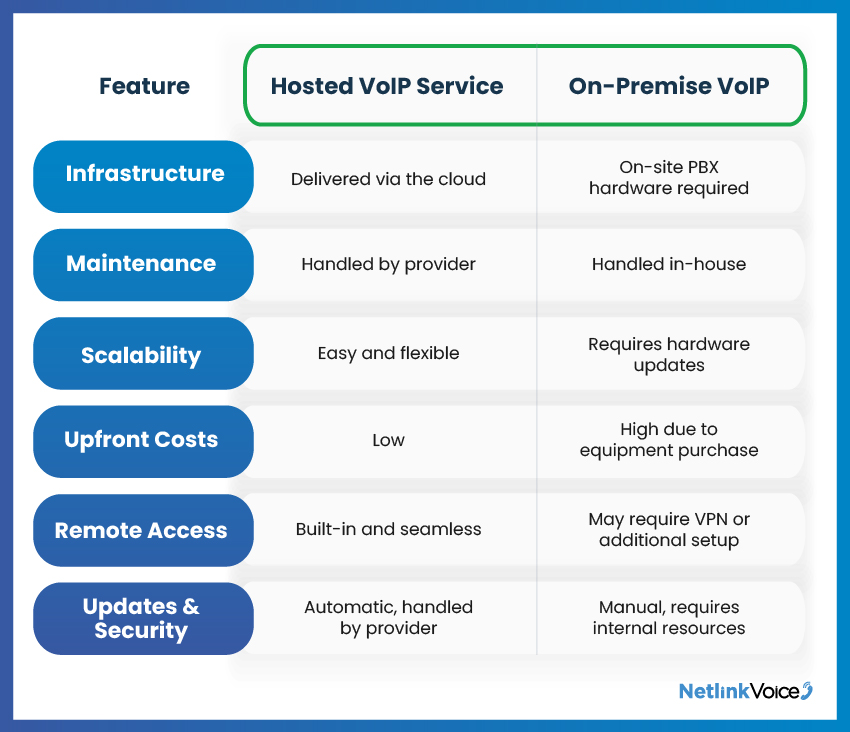
For businesses that don’t want the hassle of managing hardware – or that prioritize flexibility – hosted VoIP for business is often the smarter choice.
Hosted VoIP vs Hosted PBX vs Cloud VoIP: What’s The Difference?
These terms are often used interchangeably, and in everyday conversations there is plenty of overlap. Still, there are subtle differences that can help when you’re comparing providers or trying to understand what a platform actually includes.
Hosted VoIP
Hosted VoIP refers to a provider-managed phone service that uses internet protocol to handle voice calls. The calling infrastructure is hosted offsite, and the provider takes care of the platform, updates, and core maintenance. In other words, the “VoIP” part refers to the technology, while the “hosted” part describes the delivery model. The FCC describes VoIP broadly as technology that allows voice calls over a broadband internet connection instead of a regular analog phone line.
Hosted PBX
A hosted PBX is a cloud-based private branch exchange managed by a provider rather than housed on your premises. PBX capabilities include things like extension management, call routing, call transfer, voicemail, auto attendants, and call queues. Microsoft describes Teams Phone as a hosted telephone service that provides PBX capabilities in the cloud, while other industry definitions similarly describe hosted PBX as a provider-managed cloud phone system.
Cloud VoIP
Cloud VoIP is a broader, more flexible label that usually refers to VoIP calling delivered from the cloud. In many cases, it means almost the same thing as hosted VoIP. The difference is mostly in emphasis: “hosted VoIP” highlights that the service is managed for you by a provider, while “cloud VoIP” highlights where the service is delivered from. In practice, many vendors use the two terms interchangeably.
So Which Term Matters Most?
For most businesses, the practical question is not whether a provider says “hosted VoIP,” “cloud VoIP,” or “hosted PBX.” What matters is what the platform actually delivers. If the solution gives you cloud-managed calling, business phone features, mobile and desktop access, and the ability to scale without maintaining on-site telephony hardware, you are looking at the same general family of modern business phone systems. If it also includes messaging, video, and collaboration tools, it may be better understood as part of a UCaaS platform rather than a voice-only service.
Use Cases For Hosted VoIP For Business
Hosted VoIP offers versatility that can transform communication strategies across various business types, including:
Small To Mid-Sized Businesses
Hosted VoIP is great for SMBs looking for affordable communication tools, since it lets them access enterprise-grade phone features without investing in complex infrastructure. Even with limited IT resources, these businesses can get up and running quickly.
Growing Enterprises
As companies grow, so do their communication needs. Hosted VoIP offers scalability that supports onboarding and expansion across multiple departments and locations. It also integrates well with enterprise software to streamline workflows and improve team collaboration.
Remote & Hybrid Teams
For businesses that offer remote or hybrid work environments, hosted VoIP ensures employees stay connected no matter where they are. Teams can access the phone system from anywhere with an internet connection, creating a consistent communication experience across every location.

Customer Support & Sales Teams
Hosted VoIP solutions provide tools like call queues, call recording, CRM integration, and analytics – features that are invaluable for customer-facing teams. Sales reps and support agents can respond faster, track performance, and deliver better customer experiences.
What To Look For In A Hosted VoIP Solution
Not all hosted VoIP services are created equal. To choose the right solution for your business, it’s important to evaluate more than just price or basic calling features.
Reliability & Uptime Guarantees
Your phone system needs to work when your business needs it most. Look for a provider that offers strong uptime commitments, ideally 99.99% or higher, so your team can stay connected with minimal disruption.
Security & Compliance
Because hosted VoIP handles business communications over the internet, security should be a priority. Choose a solution that offers encryption and supports any compliance requirements relevant to your industry.
Customer Support
Responsive support can make a major difference when issues arise. A provider that offers 24/7 U.S.-based support gives your business faster access to help when it matters most.
Ease Of Use
A hosted VoIP platform should be simple for both employees and administrators to use. Intuitive interfaces, straightforward settings, and easy-to-manage admin tools help your team get more value from the system.
Integration Capabilities
Your phone system should work well with the tools your business already relies on. Look for a platform that integrates with your CRM, helpdesk software, and other core business applications.
Feature Set That Supports Growth
The best hosted VoIP solution should meet your needs today while giving you room to grow tomorrow. Prioritize the features your business depends on now, but also consider what will support your team as your operations expand.
A hosted VoIP solution is a strategic investment in your business’s communication infrastructure, so it’s worth choosing a platform that aligns with your current requirements and long-term goals.
What Is Hosted VoIP – FAQs
What Is Hosted VoIP?
Hosted VoIP is a business phone service that uses the internet to place and receive calls, while the provider manages the phone system in the cloud instead of your company maintaining it on site.
How Is Hosted VoIP Different From A Traditional Phone System?
A traditional phone system depends on on-premise hardware and legacy phone lines, while hosted VoIP routes calls over the internet and shifts system maintenance, updates, and infrastructure management to the provider.
Is Hosted VoIP The Same As Hosted PBX?
Not exactly, but the terms are closely related. Hosted VoIP refers to internet-based calling delivered as a managed service, while hosted PBX refers more specifically to the cloud-based call-control features behind that service, such as routing, voicemail, auto attendants, and extensions.
What Do Businesses Need To Use Hosted VoIP?
Most businesses need a stable internet connection, compatible calling devices, and a provider that supports the features, scalability, and reliability their teams require. For more call-heavy environments, network readiness also becomes important.
Can Hosted VoIP Support Remote And Hybrid Teams?
Yes. Hosted VoIP allows employees to use their business phone number from different locations through desk phones, laptops, or mobile apps, which makes it well suited for remote and hybrid work environments.
What Are The Main Drawbacks Of Hosted VoIP?
The biggest concerns are usually internet dependence, call-quality issues caused by network instability, and the need to evaluate provider security, uptime, and support carefully. These risks can usually be reduced with proper planning and the right provider.
Is Hosted VoIP Secure?
Hosted VoIP can be secure when it is deployed and managed properly. Businesses should look for providers that offer strong security controls, reliable infrastructure, and support for compliance requirements that apply to their industry.
Is Hosted VoIP A Good Fit For Small Businesses?
In many cases, yes. Hosted VoIP gives small and mid-sized businesses access to advanced calling features without the cost and complexity of owning and maintaining an on-premise phone system.
Upgrade To Hosted VoIP With Netlink Voice
At Netlink Voice, we believe in making business communications hassle-free. Our Connectware UCaaS platform includes powerful hosted VoIP services, mobile access, 24/7 support, and much more to keep your business connected and productive at all times. Whether you need to support a small local team or hundreds of users across multiple locations, we deliver hosted VoIP solutions that grow with your business.
Ready to modernize your phone system? Contact us today to learn how our hosted VoIP solution can transform the way you communicate.
Sources: