

Phone systems have come a long way, but many businesses still rely on tried-and-true technologies that just work. One of those technologies is PRI, or Primary Rate Interface.
While cloud-based VoIP platforms often dominate the conversation, PRI continues to support thousands of organizations that need consistent call quality and dependable performance. But what is PRI, and why do some businesses still choose it over newer options?
In this guide, we break down everything you need to know about PRI phone systems so you can see how PRI stacks up in the broader telecom landscape.
What Is A PRI?
Primary Rate Interface is a telecom standard used to deliver voice, data, or video transmissions over a single physical line. It’s part of the ISDN (Integrated Services Digital Network) group of technologies and has long been used in business phone systems, especially in environments with high call volumes.
A typical PRI circuit in North America uses a T1 line, which supports 23 voice channels and one signaling channel. In many other parts of the world, PRI uses an E1 line instead, which offers 30 voice channels plus one for signaling.
How Does A PRI Phone System Work?
A PRI phone system connects your on-site PBX to the public switched telephone network (PSTN). Unlike analog phone lines, which only handle one call at a time, PRI systems can manage multiple concurrent calls on a single circuit.
Some key features of a PRI phone system include:
- 23 concurrent voice channels on a single T1 circuit (in North America), which allows multiple simultaneous calls to happen without separate phone lines.
- Caller ID and Direct Inward Dialing (DID) to give each team member or department their own number without needing to add extra lines.
- Consistent voice quality and uptime that isn’t impacted by fluctuations in internet traffic or bandwidth.
- Point-to-point connectivity between your carrier and on-premises PBX equipment, offering a stable and secure physical connection.
If your business has already invested in PBX hardware or needs an analog failover option, a PRI system can be a smart and cost-effective way to keep communications running smoothly. It’s a helpful choice for organizations that need dedicated voice capacity without relying on internet connectivity.
4 Benefits Of PRI Circuits For Business
Many businesses stick with PRI because it offers distinct advantages over internet-based voice solutions, including:
1. Consistent Call Quality
Because PRI doesn’t depend on an internet connection, it avoids common VoIP issues like jitter, dropped packets, or latency. PRI runs voice traffic on a dedicated circuit, which helps maintain high audio quality at all times – a must for businesses where call clarity is a priority.
2. Guaranteed Bandwidth
PRI allocates a fixed number of channels per circuit, meaning bandwidth is guaranteed. You don’t have to worry about performance issues caused by other applications using the network. Each call gets its own channel, and there’s no risk of interference from video conferencing or other network activity.
3. No Need For Internet
PRI can be a dependable alternative for businesses in areas with unreliable or limited broadband access. It operates separately from your internet service, which helps reduce risk and ensure availability even when online connectivity is unstable. It also makes sense for companies that want to separate their voice and data traffic.
4. Predictable Performance
Since PRI is hardware-based, it’s more consistent than wireless alternatives. You always know how many calls it can handle, what kind of performance to expect, and how it will behave in your environment. That predictability makes it easier to plan capacity and manage telecom needs without surprises.
PRI Telecom Use Cases
PRI telecom solutions are still in active use across industries that demand high call volumes and consistent voice quality. Common use cases include:
- Healthcare: Hospitals and healthcare facilities often use PRI to provide dedicated, secure voice channels for patient communication and coordination.
- Contact Centers: Contact centers that handle high volumes of simultaneous inbound and outbound calls typically use PRI due to its consistency.
- Finance: Financial institutions often require stable, secure voice systems for client transactions and internal operations, which PRI systems deliver.
- Government: Government agencies and public safety offices use PRI wherever direct, fail-safe communication lines are essential.
- Enterprises: PRI is often the go-to for enterprises in areas with limited or unreliable internet or those that need to separate voice from data to ensure uninterrupted service.
While newer technologies like SIP trunking and VoIP offer flexibility, PRI is still popular in environments where traditional infrastructure is already in place – or where internet dependency is a concern.
PRI vs SIP vs VoIP: How Does PRI Compare?
How exactly does Primary Rate Interface compare to newer voice technologies like SIP trunking and VoIP? Here’s a quick breakdown:
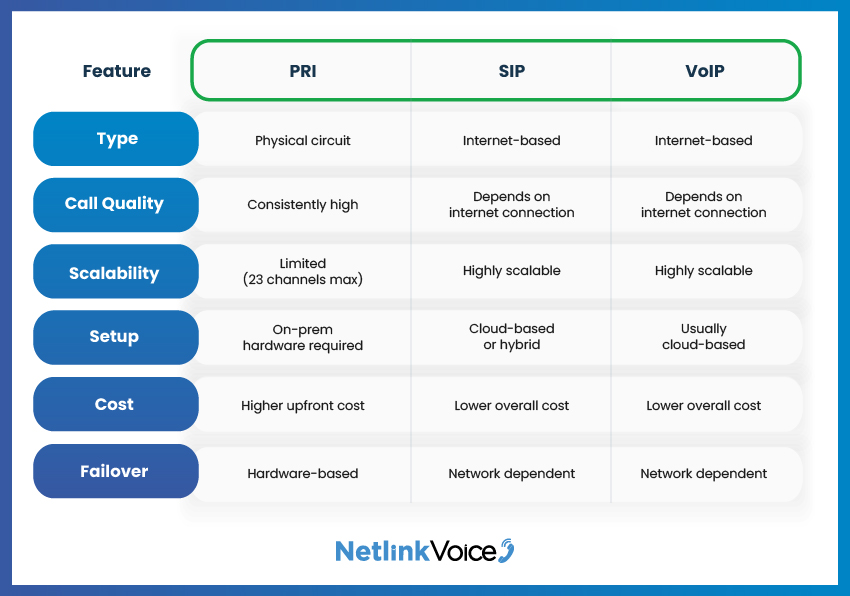
PRI is often more reliable, but less scalable and flexible than SIP or VoIP. That’s why many businesses are transitioning – but not all should.
Is PRI Still Used Today?
While PRI isn’t the cutting-edge solution it once was, it’s far from obsolete. Many telecom providers (including us at Netlink Voice) still support and manage PRI circuits for businesses that:
- Use on-site PBX systems and want to get more life out of that investment
- Operate in areas where broadband speed or reliability is a concern
- Need dedicated voice lines for mission-critical services
- Want a hybrid model that includes both VoIP and PRI for redundancy
However, it’s also true that carriers are gradually phasing out support for PRI in some regions. If you rely on PRI today, it’s a good idea to develop a long-term strategy in case your provider retires this service.
What About A Hybrid Strategy?
The telecom industry is clearly moving toward internet-based solutions like VoIP and UCaaS. Luckily, businesses that currently use a PRI phone system don’t need to make the switch all at once.
Many organizations adopt a hybrid approach, using PRI for core business calls and VoIP for overflow or remote workers. Over time, this setup allows for a gradual transition without disruption.
At Netlink Voice, we help businesses plan and implement telecom strategies that match both your current needs and future goals. That means evaluating your PRI infrastructure and mapping a path forward, whether that’s staying on PRI or moving to a more modern voice platform.
Talk To Netlink Voice About PRI And VoIP Options
If you’re evaluating PRI phone systems, planning for an upgrade, or just need help understanding your telecom options, we’re here to help. At Netlink Voice, our team brings deep experience in PRI, VoIP, and hybrid environments – and we tailor solutions to fit your goals, infrastructure, and budget.
Want to talk telecom strategy with a real human? Contact Netlink Voice to explore communications options that make sense for your business.